
Vancouver's First Winter Without Fall Back
Vancouver's First Winter Without "Fall Back": Sunrise Times, Mood, and Sleep
Sunrise reaches 9:05 a.m. on December 21 under BC's permanent Pacific time. A dated, calculated look at the darker mornings and the research on mood and sleep.
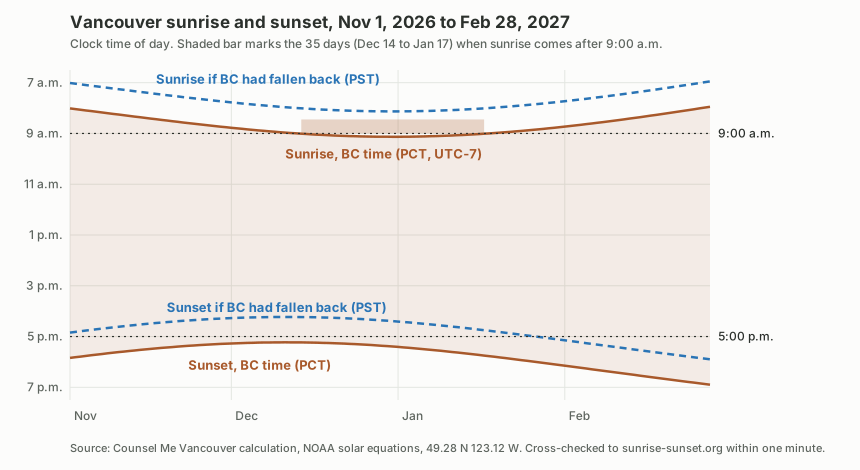
British Columbia's clocks stay where they are on November 1, 2026. Washington State falls back that day, so Vancouver runs one hour ahead of Seattle until March 2027. Vancouver's sunrise on December 21 lands at 9:05 a.m. and sunset at 5:16 p.m. Sunrise falls after 9:00 a.m. on 35 mornings, from December 14 to January 17.
Winter already brings low mood, withdrawal, and disrupted sleep to a share of Vancouver residents. Erica Beauchamp, M.Ed., RCC, reports that Counsel Me Vancouver clients tend to feel lower and more isolated in winter and usually blame the rain and the darkness. This page sets out the calculated light, the published research, and the limits of that research. Depression counselling and anxiety and stress management counselling address the winter patterns described here. No study measures what permanent daylight time does to mood in BC, and this page makes no such claim.
Key Takeaways
- November 1, 2026 brings no clock change in BC. Washington falls back, leaving a one-hour gap through March (BC government, March 2 and September 17, 2026).
- The winter solstice sunrise is 9:05 a.m. and sunset 5:16 p.m. Daylight lasts 8 hours 11 minutes (calculated, NOAA solar equations).
- Sunrise falls after 9:00 a.m. on 35 of 120 mornings, after 8:30 on 83, and after 8:00 on 118 (November 1 to February 28, calculated).
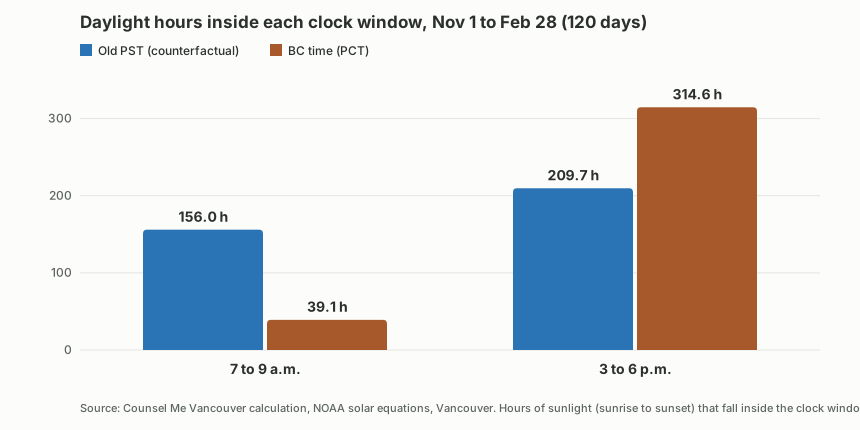
- The clock change swaps light, it does not add any. Daylight inside the 7 to 9 a.m. window drops from 156.0 to 39.1 hours, and daylight inside the 3 to 6 p.m. window rises from 209.7 to 314.6 hours.
- A Danish study of 185,419 hospital contacts linked the autumn clock change to an 11% rise in depressive episodes (95% confidence interval 7 to 15%), fading over about 10 weeks. The study measured a transition, not a permanent offset (Hansen et al., Epidemiology, 2017).
- Cognitive behavioural therapy for seasonal affective disorder (SAD) showed a 27.3% recurrence rate at the second winter, against 45.6% for light therapy in a 177-adult trial (Rohan et al., American Journal of Psychiatry, 2016).
What Just Happened: BC Stops Changing Its Clocks
British Columbia changed its clocks for the last time on March 8, 2026, and the province now keeps Pacific time (PCT) at UTC-7 all year. The BC government names health, family routines, simpler scheduling, and an extra hour of evening light in winter as its reasons. The sequence runs as follows:
- March 2, 2026: Premier David Eby announces permanent daylight time (BC Government News).
- March 8, 2026: BC makes its final clock change.
- September 17, 2026: the province names the year-round zone Pacific time, code PCT, at UTC-7. PCT replaces the PST and PDT labels.
- November 1, 2026: BC stays put. Washington, Oregon, and California fall back.
The government cites a 2019 survey with 223,000 participants, 93% of whom preferred year-round daylight time. The survey offered two options, switching clocks or permanent daylight time, and left out permanent standard time, according to Canadian Press reporting on researchers Wendy Hall (UBC) and the authors of an October 2026 analysis in the Canadian Medical Association Journal.
Washington needs Congress to match BC. The state passed a permanent daylight time law in 2019 by a House vote of 89 to 7, but federal law lets states adopt permanent standard time alone and requires congressional approval for permanent daylight time. The US House passed the Sunshine Protection Act (H.R. 139) on July 14, 2026, by 308 to 117, and the Senate has not acted.
Two regions sit outside the change. Northeastern BC communities on Mountain time, including Dawson Creek and Fort St. John, keep UTC-7 year-round, the same offset as PCT. Southeastern communities including Cranbrook, Fernie, and Kimberley stay on Mountain daylight time (UTC-6) year-round with Alberta. The sunrise figures on this page apply to communities on Pacific time.
Vancouver Sunrise and Sunset, November 2026 to February 2027
Vancouver's sunrise stays after 8:00 a.m. on 118 of the 120 days from November 1 to February 28, and the latest sunrise is 9:08 a.m. on December 31. The earliest sunset is 5:14 p.m. around December 11 to 13. Under the old November clock change, sunset falls before 5:00 p.m. on 87 of those days. Under BC's Pacific time, no day has a sunset before 5:00 p.m.
| Date | Sunrise, BC time (PCT) | Sunset, BC time (PCT) | Daylight | Sunrise, old PST | Sunset, old PST |
|---|---|---|---|---|---|
| Nov 1, 2026 | 8:01 a.m. | 5:51 p.m. | 9 h 50 min | 7:01 a.m. | 4:51 p.m. |
| Nov 8 | 8:12 a.m. | 5:40 p.m. | 9 h 28 min | 7:12 a.m. | 4:40 p.m. |
| Nov 15 | 8:23 a.m. | 5:30 p.m. | 9 h 07 min | 7:23 a.m. | 4:30 p.m. |
| Nov 22 | 8:34 a.m. | 5:23 p.m. | 8 h 49 min | 7:34 a.m. | 4:23 p.m. |
| Nov 29 | 8:44 a.m. | 5:18 p.m. | 8 h 34 min | 7:44 a.m. | 4:18 p.m. |
| Dec 6 | 8:53 a.m. | 5:14 p.m. | 8 h 22 min | 7:53 a.m. | 4:14 p.m. |
| Dec 13 | 9:00 a.m. | 5:14 p.m. | 8 h 14 min | 8:00 a.m. | 4:14 p.m. |
| Dec 20 | 9:05 a.m. | 5:16 p.m. | 8 h 11 min | 8:05 a.m. | 4:16 p.m. |
| Dec 21 (solstice) | 9:05 a.m. | 5:16 p.m. | 8 h 11 min | 8:05 a.m. | 4:16 p.m. |
| Dec 27 | 9:07 a.m. | 5:20 p.m. | 8 h 13 min | 8:07 a.m. | 4:20 p.m. |
| Jan 3, 2027 | 9:08 a.m. | 5:27 p.m. | 8 h 19 min | 8:08 a.m. | 4:27 p.m. |
| Jan 10 | 9:05 a.m. | 5:35 p.m. | 8 h 30 min | 8:05 a.m. | 4:35 p.m. |
| Jan 17 | 9:01 a.m. | 5:45 p.m. | 8 h 44 min | 8:01 a.m. | 4:45 p.m. |
| Jan 24 | 8:54 a.m. | 5:56 p.m. | 9 h 02 min | 7:54 a.m. | 4:56 p.m. |
| Jan 31 | 8:45 a.m. | 6:07 p.m. | 9 h 22 min | 7:45 a.m. | 5:07 p.m. |
| Feb 7 | 8:35 a.m. | 6:19 p.m. | 9 h 44 min | 7:35 a.m. | 5:19 p.m. |
| Feb 14 | 8:23 a.m. | 6:31 p.m. | 10 h 08 min | 7:23 a.m. | 5:31 p.m. |
| Feb 21 | 8:10 a.m. | 6:42 p.m. | 10 h 32 min | 7:10 a.m. | 5:42 p.m. |
| Feb 28 | 7:57 a.m. | 6:54 p.m. | 10 h 57 min | 6:57 a.m. | 5:54 p.m. |
Weekly sample from the daily calculation, November 1, 2026 to February 28, 2027. The old Pacific Standard Time columns show the clock times the November clock change produces.
Online sunrise tables still show standard-time values. One travel-weather site lists Vancouver's December 1 sunrise at 7:47 a.m. and its December 31 sunrise at 8:08 a.m. Those values match the Pacific Standard Time column above. Under BC's Pacific time the same days read 8:47 a.m. and 9:08 a.m. Any sunrise table for Vancouver needs its UTC offset stated beside the times.
A Swap, Not a Gain: Where the Daylight Falls on the Clock
Permanent daylight time moves the same daylight from the morning to the afternoon. Total daylight stays identical, and Stanford researchers made the same point in their 2025 study: time policy changes where sunrise and sunset fall on the clock and adds no light to winter months. Between November 1 and February 28, daylight inside the 7 to 9 a.m. window falls by 116.9 hours, and daylight inside the 3 to 6 p.m. window rises by 104.9 hours.
| Clock window (Nov 1 to Feb 28) | BC time (PCT) | Old PST | Difference |
|---|---|---|---|
| 7 to 9 a.m. | 39.1 hours | 156.0 hours | -116.9 hours |
| 8 to 9 a.m. | 39.0 hours | 116.9 hours | -77.9 hours |
| 3 to 6 p.m. | 314.6 hours | 209.7 hours | +104.9 hours |
| 5 to 6 p.m. | 74.6 hours | 15.0 hours | +59.6 hours |
35 Mornings After 9:00 A.M.
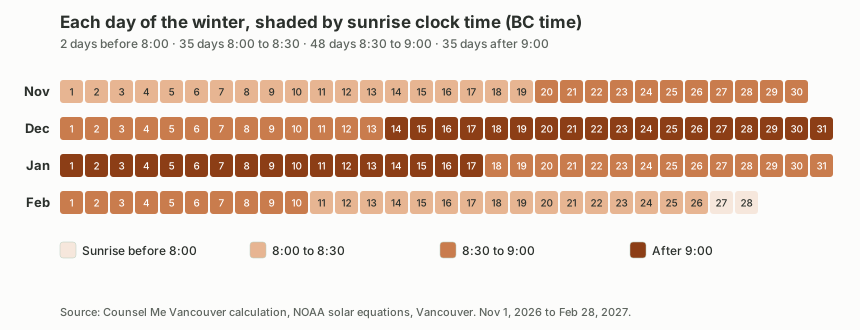
Sunrise in Vancouver falls after 9:00 a.m. on 35 mornings from December 14 to January 17, between 8:30 and 9:00 a.m. on 48 mornings, and between 8:00 and 8:30 a.m. on 35 mornings. The BC Medical Journal reached the same range in its May 2026 editorial: sunrise after 8:00 a.m. for almost 4 months and after 9:00 a.m. for about 1 month.
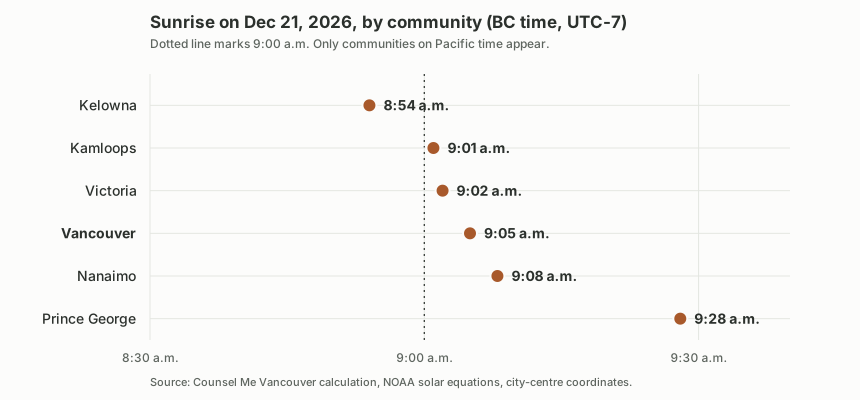
Communities across Pacific-time BC see similar mornings. Sunrise on December 21 arrives at 8:54 a.m. in Kelowna, 9:01 in Kamloops, 9:02 in Victoria, 9:05 in Vancouver, 9:08 in Nanaimo, and 9:28 in Prince George.
What Researchers Report, and Where the Evidence Stops
No published study measures what permanent daylight time does to mood in British Columbia, because the policy took effect in March 2026. The research that exists covers clock transitions, circadian biology, and expert prediction. The table lists each source with its date and its limit.
| Source and date | What it reports | Limit |
|---|---|---|
| Hansen et al., Epidemiology (2017), Danish hospital register, 1995 to 2012 | The autumn change to standard time associated with an 11% rise (95% CI 7 to 15%) in unipolar depressive episodes across 185,419 hospital contacts, fading over about 10 weeks. No comparable change at the spring transition. | Measures a transition in Denmark, not a permanent offset. Covers hospital-treated depression. The authors offer hypotheses, such as less benefit from morning daylight, and no proven mechanism. |
| CMAJ analysis, October 5, 2026 (as reported by the Canadian Press) | Authors including Ralph Mistlberger (SFU) and Patrick Baylis (UBC) favour permanent standard time, and recommend monitoring adolescents and considering later school starts if BC keeps daylight time. | Reported through news coverage. Some cited evidence is epidemiological and associational. |
| Keys and Hall, UBC nursing commentary, March 9, 2026 | Permanent daylight time removes winter morning light and adds social jetlag, with adolescents at greatest risk. | Commentary, not new data. Presents no BC measurements. |
| Stanford/PNAS modelling study, September 15, 2025 | Both permanent options beat twice-yearly switching. Permanent standard time benefits the most people, and permanent daylight time delivers about two-thirds of that benefit. | Modelled, not a trial. Excludes weather, geography, and behaviour. The authors describe the results as not conclusive enough to outweigh other considerations. |
| Dr. Raymond Lam, UBC Mood Disorders Centre, November 4, 2022 | Predicts permanent daylight time likely raises the prevalence and severity of seasonal affective disorder. | Expert prediction made before the change. Not a measured outcome. |
| Schwandt, BC Medical Journal editorial, May 2026 | The trade-offs between evening daylight and circadian disruption are hard to quantify. Calls for anticipating, studying, and mitigating harms. | Editorial. No formal recommendation. |
| BC government, March 2 and September 17, 2026 | Cites health, fewer family disruptions, simpler scheduling, and an extra hour of evening light in winter. | The release gives no sunrise times and no specific health figures. |
| American Academy of Sleep Medicine (2024) and Canadian Sleep Society | Both recommend permanent standard time. | Position statements on clock policy, not measurements of BC outcomes. |
The Danish finding applies to a different situation from BC's. BC skips the autumn transition entirely, so the specific event Hansen et al. studied does not occur in Vancouver this year. The later sunrise replaces it, and no study yet shows which effect dominates.
Winter Mood in Vancouver: Cloud, Latitude, and Practice Experience
Seasonal affective disorder (SAD) is depression that recurs at a particular time of year, usually starting in fall and lasting through winter. HeretoHelp BC reports that about 2 to 3% of Canadians have SAD in their lifetime, another 15% have a milder form, and SAD accounts for about 10% of all depression. Risk runs higher in northern regions than near the equator.
Vancouver's winter light is mostly cloud. Environment Canada's 1981 to 2010 normals for Vancouver International Airport record 56.5 hours of bright sunshine in December, about 1.8 hours per day, and measurable precipitation on 19.7 days. A typical overcast Vancouver day produces 1,000 to 2,000 lux of light, against up to 120,000 lux in the brightest sunshine, according to a 2016 Ubyssey article featuring Dr. Raymond Lam.
Erica Beauchamp reports that Counsel Me Vancouver clients usually feel more depressed, isolated, and low in winter, and tend to blame the rain and the darkness. That is a practice observation, not a statistic. The calculated table above shows the clock side of that darkness: the latest sunrise of the year arrives at 9:08 a.m. on December 31, and sunset lands at 5:16 p.m. on the solstice.
Light Therapy: The UBC Protocol and the 9:00 A.M. Sunrise
The UBC Mood Disorders Centre describes light therapy as a medical treatment for SAD that starts with a 10,000 lux light box for 30 minutes per day. UBC's procedure starts treatment in the early morning, between 6:00 and 9:00 a.m., soon after waking. A 5,000 lux box requires 45 to 60 minutes, and a 2,500 lux box requires 1 to 2 hours. Response usually begins within a few days, and symptoms clearly improve by two weeks. HeretoHelp BC reports that 60 to 80% of people with SAD find substantial relief with light therapy.
Under BC's Pacific time, sunrise falls after 9:00 a.m. on 35 mornings, so natural daylight does not reach the 6:00 to 9:00 a.m. window in which the UBC protocol schedules treatment on those days.
Light therapy needs a doctor's input first. UBC advises consulting a doctor before use with bipolar disorder, retinal disease, macular degeneration, diabetes, or other eye concerns, and advises stopping and contacting a doctor if irritability or euphoria appears. Mild headaches, nausea, or eye strain occur at the start and usually ease within a few days. Treatment runs under the supervision of a qualified health professional. A family doctor or HealthLink BC (811) answers whether light therapy fits a specific person. Counsel Me Vancouver counsellors do not prescribe light boxes.
Counselling and Winter Depression: The CBT Evidence
Cognitive behavioural therapy tailored for SAD (CBT-SAD) matched light therapy in the first winter after treatment and outperformed it in the second. Rohan et al. (American Journal of Psychiatry, 2016) randomized 177 adults with recurrent, seasonal-pattern major depression to 6 weeks of CBT-SAD (88 adults) or light therapy (89 adults). The groups did not differ in the first follow-up winter. At the second winter, recurrence reached 27.3% with CBT-SAD against 45.6% with light therapy, and remission, defined as a Beck Depression Inventory-II score of 8 or lower, reached 68.3% against 44.5%.
The trial studied people with a formal seasonal-pattern depression diagnosis, and its authors describe the second-winter result as suggesting greater durability for CBT-SAD. Cognitive behavioural therapy is one of the modalities Counsel Me Vancouver counsellors use for depression and anxiety. A free consultation covers whether a counselling approach fits a specific winter pattern.
What To Do Now: Winter Steps From Published Sources
- Note the calendar. December 14 to January 17 carries the 35 mornings with sunrise after 9:00 a.m.
- Get outside in daylight. HeretoHelp BC lists outdoor time during daylight, a midday walk, open curtains, and regular exercise among its winter self-help steps.
- See a doctor when winter lows recur. HeretoHelp BC advises seeing a doctor when symptoms return each year or affect daily life, and advises against self-diagnosis. A doctor rules out other causes, such as thyroid problems.
- Ask about light therapy before buying a lamp. The UBC protocol and its precautions appear above.
- Book a conversation. Depression counselling, anxiety and stress management counselling, and individual counselling run by secure video from anywhere in BC or in person in Vancouver, with a free consultation before the first session.
In an emergency, call 911. The Suicide Crisis Helpline is reachable by calling or texting 988, any time.
Frequently Asked Questions
Does BC fall back on November 1, 2026?
No. Most of BC keeps its clocks as they are, and Pacific time (PCT, UTC-7) replaces the PST and PDT labels. Washington falls back that day, so Vancouver runs one hour ahead of Seattle until March 2027. Mountain-time communities in northeastern and southeastern BC keep their own arrangements.
What time does the sun rise in Vancouver in December 2026?
Sunrise runs from 8:47 a.m. on December 1 to 9:05 a.m. on December 21 and 9:08 a.m. on December 31 under BC's Pacific time. Sunset runs from 5:16 p.m. on December 1 to 5:16 p.m. on December 21 and 5:25 p.m. on January 1. Calculated with NOAA solar equations and cross-checked to sunrise-sunset.org.
Does permanent daylight time cause depression?
No study measures that in BC yet. A Danish study linked the autumn clock change to an 11% rise in depressive episodes, a different situation from a permanent offset. UBC's Dr. Raymond Lam predicts higher SAD prevalence and severity under permanent daylight time. That is an expert prediction, not a measured result.
What time of day suits light therapy for winter depression?
The UBC Mood Disorders Centre procedure starts light therapy in the early morning, between 6:00 and 9:00 a.m., soon after waking, for 30 minutes at 10,000 lux. A doctor confirms whether light therapy fits first, particularly with bipolar disorder or eye conditions.
How much sun does Vancouver get in winter?
Vancouver International Airport records 60.4 hours of bright sunshine in November, 56.5 in December, 60.1 in January, and 91.0 in February (Environment Canada, 1981 to 2010 normals). December works out to about 1.8 hours per day, with measurable precipitation on 19.7 days.
Sources and Method
Method. Sunrise and sunset times come from the NOAA solar-position equations for Vancouver (49.28 N, 123.12 W), using the standard sunrise definition, at UTC-7 for BC's Pacific time and UTC-8 for the old Pacific Standard Time comparison. The values match sunrise-sunset.org to within one minute on December 1, 15, 21, and 31. Daylight-window hours sum the portion of each day's sunrise-to-sunset period that falls inside the clock window, from November 1, 2026 to February 28, 2027. Weather is excluded. Daylight is the astronomical period between sunrise and sunset, not measured sunshine.
- BC Government, Permanent daylight saving time (published September 17, 2026) and Adopting permanent daylight saving time (March 2, 2026).
- US House of Representatives Clerk, Roll Call 238, H.R. 139 (July 14, 2026).
- KIRO 7 / MyNorthwest, B.C. ends daylight saving time permanently in 2026; WA is still waiting on Congress (March 3, 2026).
- Hansen BT, Sønderskov KM, Hageman I, Dinesen PT, Østergaard SD. Daylight savings time transitions and the incidence rate of unipolar depressive episodes. Epidemiology 2017;28(3):346-353.
- Rohan KJ, Meyerhoff J, Ho SY, Evans M, Postolache TT, Vacek PM. Outcomes one and two winters following cognitive-behavioral therapy or light therapy for seasonal affective disorder. Am J Psychiatry 2016;173(3):244-251.
- Weed L, Zeitzer J et al., Stanford Medicine, PNAS study on permanent time options (September 15, 2025).
- Canadian Press via CP24, Clocks stay in daylight saving, but analysis backs permanent standard time (October 5, 2026), reporting a Canadian Medical Association Journal analysis.
- Canadian Press via Calgary Journal, Premier Eby says B.C. will make daylight time permanent (March 2, 2026).
- Keys E, Hall W. UBC News / The Conversation, B.C.'s switch to permanent DST adds to the perfect storm for poorer adolescent sleep and mental health (March 9, 2026).
- Schwandt M. Shining light on permanent daylight saving time and health. BC Medical Journal 2026;68(4):122.
- Djavad Mowafaghian Centre for Brain Health, Why daylight savings time is actually bad for our mental and physical health (November 4, 2022), Dr. Raymond Lam.
- UBC Mood Disorders Centre, Light therapy procedure for using the 10,000 lux fluorescent light box.
- HeretoHelp BC, Seasonal affective disorder.
- The Ubyssey, Feeling SAD? Blame the season (and the rain) (November 25, 2016), Dr. Raymond Lam.
- Environment and Climate Change Canada, Canadian Climate Normals 1981 to 2010, Vancouver Int'l A (climate ID 1108447), via the MSC GeoMet API.
- American Academy of Sleep Medicine, Permanent standard time is the optimal choice for health and safety (Rishi et al., J Clin Sleep Med 2024;20(1):121-125). Canadian Sleep Society, Position statement on daylight saving time.
- sunrise-sunset.org, Vancouver, December 2026 (cross-check), and weather2travel.com, Vancouver in December (standard-time comparison).
Last updated: October 21, 2026. This page is informational and does not replace advice from a doctor. Counsel Me Vancouver refreshes the figures after the winter ends.
Start With a Free Consultation
A free consultation covers what winter support looks like, by video from home or in person in Vancouver.
Book a Consultation